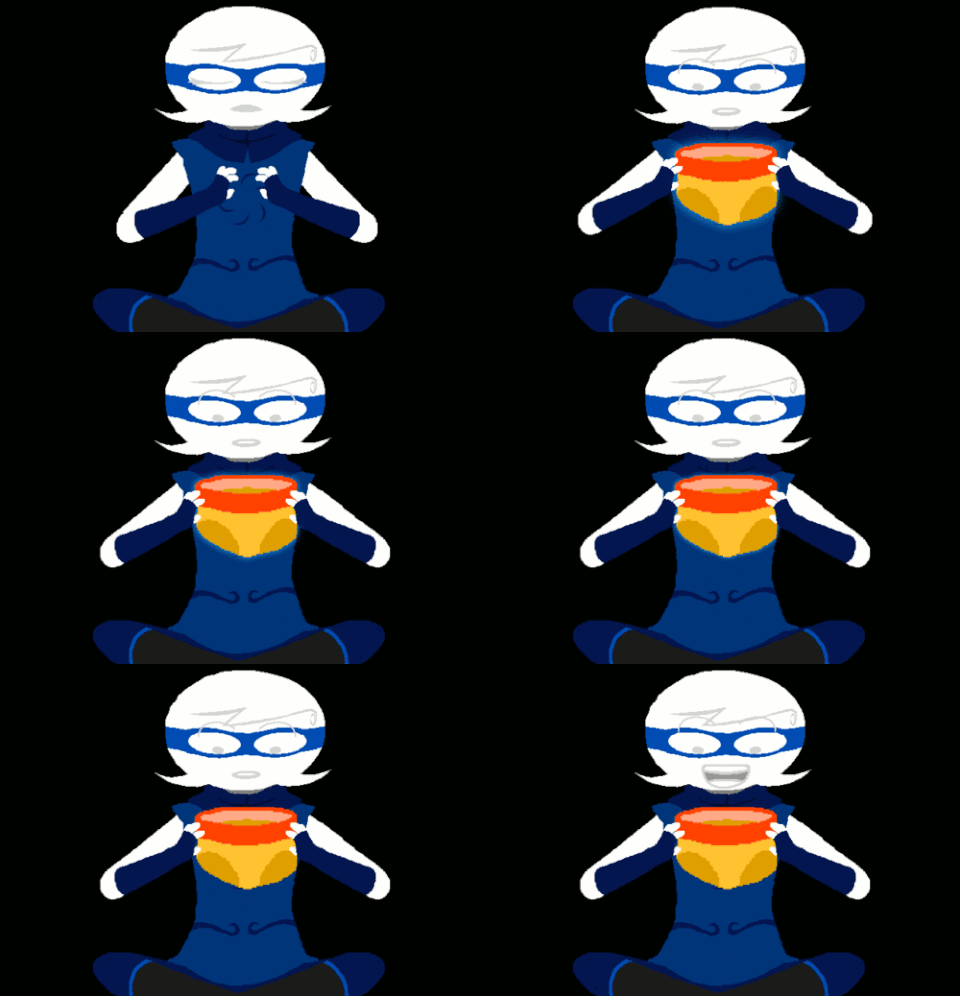
What’s fun about Homestuck, to me, is that it’s a narrative playground, less character-driven in the classic sense and more “hey, let’s throw all these archetypes together and see what happens”.
The logic here is similar to what we can find in the commedia dell’arte: everyone plays a role which guides them through the narrative. But there’s a certain leeway with personal characteristics that makes them unique in their own universe, even if, on the grand scale of theatre, they still align with what’s “expected” of them.
And so, an arlecchino is an arlecchino. Even if their dialogue changes from play to play, as long as they maintain their own mask, the public will recognize them.
Following this same thesis, I would say that classpects act as the determined mask of each character. It shapes them as much as it is a natural projection of their own self. It is a self-fulfilling prophecy, an Ouroboros of its own nature.
In canon, we are told void players are:
“(...) the universe’s secret-keepers. The unknown doesn’t scare them—where others might see emptiness, they see potential. A blank page, an empty canvas, that’s what the Void-bound live for. They value mystery and the unexplained, and are not particularly bothered by not having all the answers. Where others might be compelled to go out and seek answers, the Void-bound lean more toward casting doubt on what is already considered fully understood. They don’t take much on faith and would rather live in a state of confusion than believe something that might be untrue or bow to intellectual authority. After all, in order for something new to be built, the old, rotting foundation must often be razed. At their best, Void-bound are wise, intuitive, and vibrant. At their worst they can be dismissive, indecisive, and apathetic.”
How fruitful and bountiful the Void can be as an aspect and concept. It's not the presence of something quantifiable at first glance, as one would think with the Life aspect, but more so the promise of it. The void is the threshold between fullness and nothing, between loud day and quiet night. It's not denial, but it isn't acceptance either. It's in this play that Roxy represents liminality in the same way as the Gnostic Sophia, who existed in the state between what was and what is. They are both the manifestation of the pregnant pause of the spoken being given form.
Roxy's drunken stupor represents the void very metaphorically, but it presents itself in its more damaging form. Instead of the promise of something, it was the nullification of it. The void as the endless shadow that lurks on the edge of the world.
Later on, as she ascends to godhood, Roxy's power becomes a literal manifestation of itself as a complete classpect: the Rogue of Void is capable of redistributing void; she steals from it, making it possible for things to exist.
But I believe Roxy's later (non-canonical) gender expression reveals the true potential of the Void. In both universes, they're shown to be either a trans masc or a cis girl. I believe this is indicative of the possibility of a multiplicity of genders capable of expressing themselves at any point of gender that lies between the binary and beyond. There's no denying the possibility that Roxy can be a cis boy, a trans woman, agender, etc. Their body and expression are the ultimate embodiment of multiplicity, thought given form.